live - 60fps 1920 x 1080
<!DOCTYPE html>
<html lang="en">
<head>
    <meta charset="UTF-8">
    <meta name="viewport" content="width=device-width, initial-scale=1.0">
    <title>Animated Background - Particle Field</title>
    <style>
        body {
            margin: 0;
            overflow: hidden; /* Important to prevent scrollbars */
            background-color: #1a1a2e; /* Dark background for contrast */
            cursor: none; /* Hide default cursor to let particles shine */
        }
        canvas {
            display: block; /* Remove extra space below canvas */
        }
    </style>
</head>
<body>
    <canvas id="particleCanvas"></canvas>
    <script>
        const canvas = document.getElementById('particleCanvas');
        const ctx = canvas.getContext('2d');
        let particles = [];
        const numParticles = 100; // Number of particles
        const maxRadius = 3;      // Max particle size
        const minRadius = 1;      // Min particle size
        const speed = 0.5;        // Particle movement speed
        const lineColor = 'rgba(100, 180, 255, 0.1)'; // Line color (subtle blue)
        const particleColor = 'rgba(100, 180, 255, 0.7)'; // Particle color (brighter blue)
        const linkDistance = 150; // Max distance for particles to link
        let mouse = {
            x: undefined,
            y: undefined
        };
        // Set canvas size to full window
        function resizeCanvas() {
            canvas.width = window.innerWidth;
            canvas.height = window.innerHeight;
        }
        // Particle constructor
        function Particle(x, y, radius, dx, dy) {
            this.x = x;
            this.y = y;
            this.radius = radius;
            this.dx = dx;
            this.dy = dy;
            this.draw = function() {
                ctx.beginPath();
                ctx.arc(this.x, this.y, this.radius, 0, Math.PI * 2, false);
                ctx.fillStyle = particleColor;
                ctx.fill();
            };
            this.update = function() {
                // Bounce off walls
                if (this.x + this.radius > canvas.width || this.x - this.radius < 0) {
                    this.dx = -this.dx;
                }
                if (this.y + this.radius > canvas.height || this.y - this.radius < 0) {
                    this.dy = -this.dy;
                }
                this.x += this.dx;
                this.y += this.dy;
                this.draw();
            };
        }
        // Initialize particles
        function init() {
            particles = [];
            for (let i = 0; i < numParticles; i++) {
                let radius = Math.random() * (maxRadius - minRadius) + minRadius;
                let x = Math.random() * (canvas.width - radius * 2) + radius;
                let y = Math.random() * (canvas.height - radius * 2) + radius;
                let dx = (Math.random() - 0.5) * speed; // Random direction for x
                let dy = (Math.random() - 0.5) * speed; // Random direction for y
                particles.push(new Particle(x, y, radius, dx, dy));
            }
        }
        // Animate loop
        function animate() {
            requestAnimationFrame(animate);
            ctx.clearRect(0, 0, canvas.width, canvas.height); // Clear canvas
            for (let i = 0; i < particles.length; i++) {
                particles[i].update();
                // Draw lines between close particles
                for (let j = i + 1; j < particles.length; j++) {
                    const dist = Math.sqrt(
                        Math.pow(particles[i].x - particles[j].x, 2) +
                        Math.pow(particles[i].y - particles[j].y, 2)
                    );
                    if (dist < linkDistance) {
                        ctx.beginPath();
                        ctx.moveTo(particles[i].x, particles[i].y);
                        ctx.lineTo(particles[j].x, particles[j].y);
                        ctx.strokeStyle = lineColor;
                        ctx.lineWidth = 0.5;
                        ctx.stroke();
                    }
                }
                // Link to mouse position
                if (mouse.x !== undefined && mouse.y !== undefined) {
                    const distToMouse = Math.sqrt(
                        Math.pow(particles[i].x - mouse.x, 2) +
                        Math.pow(particles[i].y - mouse.y, 2)
                    );
                    if (distToMouse < linkDistance * 1.5) { // Slightly larger link distance for mouse
                        ctx.beginPath();
                        ctx.moveTo(particles[i].x, particles[i].y);
                        ctx.lineTo(mouse.x, mouse.y);
                        ctx.strokeStyle = lineColor;
                        ctx.lineWidth = 0.5;
                        ctx.stroke();
                    }
                }
            }
        }
        // Event Listeners
        window.addEventListener('resize', () => {
            resizeCanvas();
            init(); // Reinitialize particles on resize
        });
        window.addEventListener('mousemove', (event) => {
            mouse.x = event.x;
            mouse.y = event.y;
        });
        window.addEventListener('mouseout', () => {
            mouse.x = undefined;
            mouse.y = undefined;
        });
        // Initial setup
        resizeCanvas();
        init();
        animate();
    </script>
</body>
</html>About this animation
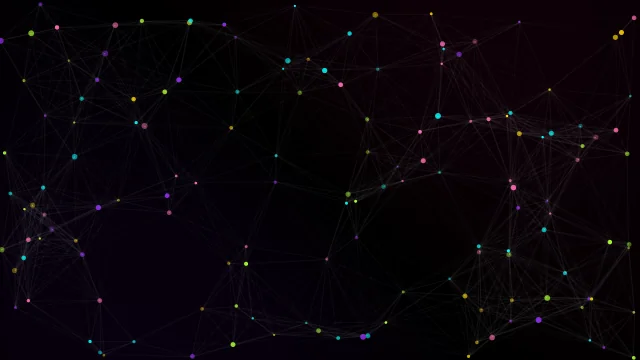
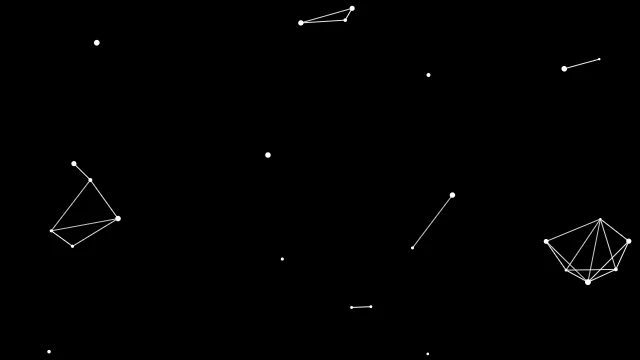
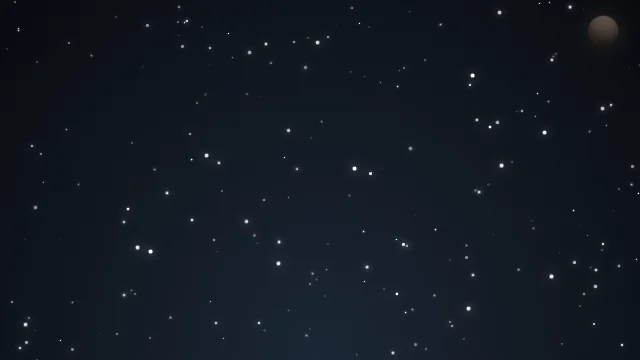
Dense field of moving particles.
Under the hood
Vector Velocity Rendering
A classic starfield or particle field. Elements are assigned random depths (Z-index equivalents). Elements further away are drawn smaller and move slower (parallax) while foreground elements move faster, creating a strong illusion of 3D depth using purely 2D canvas calculations.
Related